You don’t inherit code. You inherit every decision nobody explained.
What you actually inherit when you take over someone else’s software, and how a year at Zudu changed the way I hand it over.
TL;DR
- Inheriting software is rarely about the code. The hard part is every decision nobody wrote down.
- Signing keys, account owners, live branches and logins all lived in someone’s head, and that someone had moved on.
- A good handover lists every service and its owner, transfers things in a safe order, has a way back for every step and writes known issues down before sign-off.
- With AI writing more of our code, I built a shared plugin so everyone’s assistant works from the same Zudu standards.
- Judge it by your newest starter, not your best engineer.
Day one
I joined Zudu in November 2025. Within days, I’d been handed an app I’d never seen before. The people who’d built it, and made every decision inside it, weren’t around to ask. My first job was to get it through the App Store.
Two weeks later, I posted three words to the team: “We have a build!” It doesn’t sound like much, but almost none of the work behind it was writing code.
The code wasn’t the hardest part
When people talk about inheriting software, they usually mean code quality: messy components, missing tests, outdated packages. None of it was ideal, but at least I could see what needed fixing. The harder problems were the ones the code couldn’t explain.
In my first few weeks, the real blockers had nothing to do with code. We couldn’t ship an Android update until we’d tracked down the right signing key. Apple wouldn’t accept a release until the account holder signed a new agreement, and it took a while to work out who that even was.
Then came the smaller puzzles:
- Which branch was actually live?
- Who had the login for error monitoring?
- Why had a feature stopped working overnight?
Every answer lived in someone’s head, and that someone had moved on.
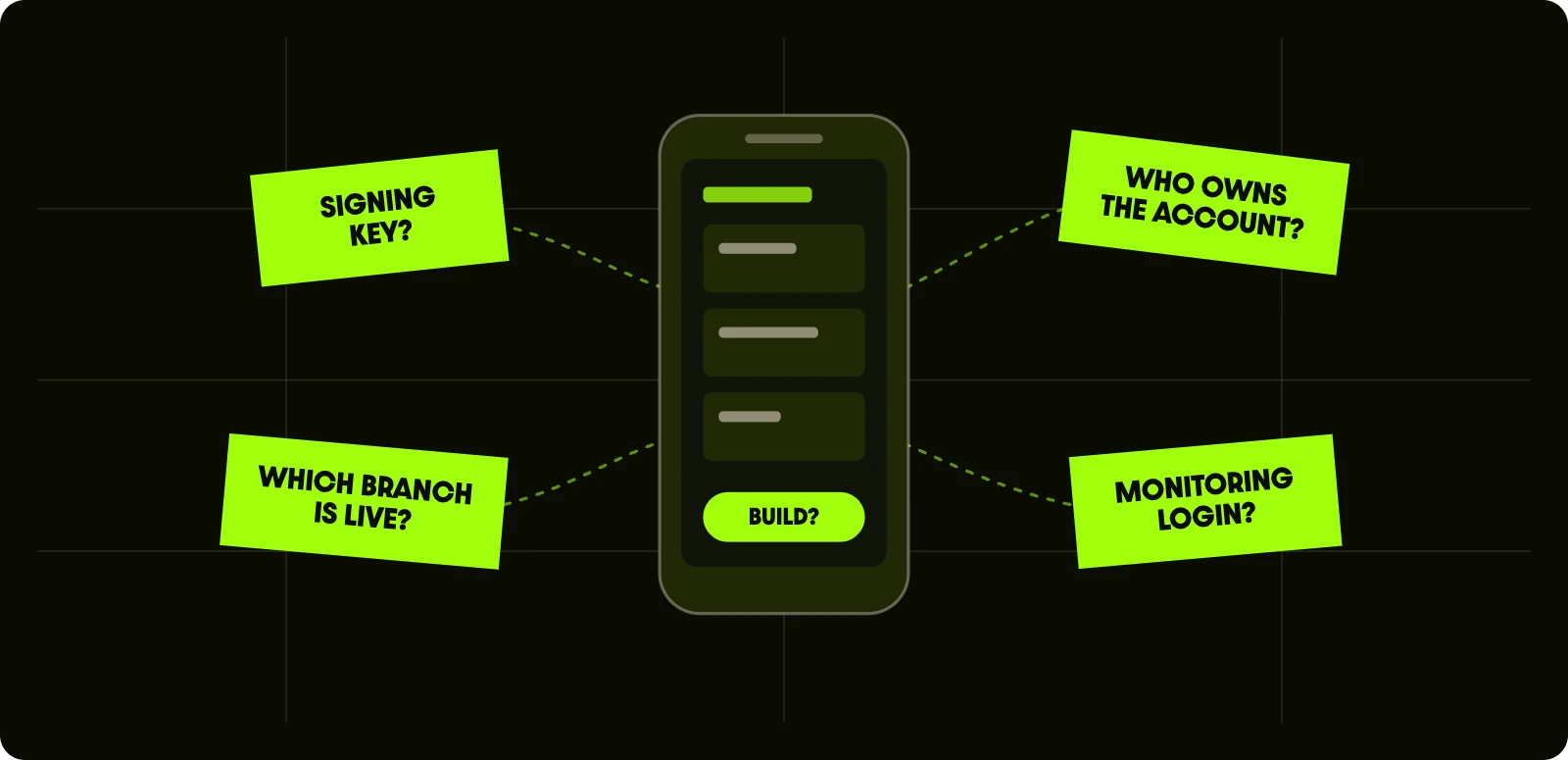
None of this was written down because, to the people who made those calls, it was obvious. Every undocumented decision feels obvious to the person who made it, and is a mystery to everyone who comes after. You don’t inherit code. You inherit every decision nobody explained.
Every undocumented decision feels obvious to the person who made it, and is a mystery to everyone who comes after.
It also changed how I start new work. On a recent client project, before writing any code, I sent over a handful of questions about how their business actually runs. None of them were technical, but getting them wrong would have made the code wrong, however clean it looked.
Then it was my turn to hand over
Later in the year, that same app went back to the client, and this time I was the one handing it over.
Having been on the receiving end, I knew what I wanted the handover to include:
- Every service listed with a clear owner
- Transfers done in an order where nothing breaks halfway
- A way back for every step
- Every known issue written down before sign-off, rather than discovered after

Even then, I got things wrong. An early draft marked a couple of services as no longer in use, and when I checked the code, they were very much live. A handover written from memory is just another decision nobody explained.
A handover written from memory is just another decision nobody explained.
A single source of truth
The obvious fix for all of this is documentation. But most documentation fails in the same way: it lives somewhere nobody looks at the moment they need it. A wiki page on branch naming doesn’t help much at 5pm when you’re rushing out a hotfix.
AI made this more pressing. More and more of our code was being written with an AI assistant, and each developer’s assistant only knew what that developer had told it. Two people could ask for the same feature and get code that followed two different sets of rules, and neither was guaranteed to match ours. Zudu already had an engineering playbook. The AI just wasn’t reading it.
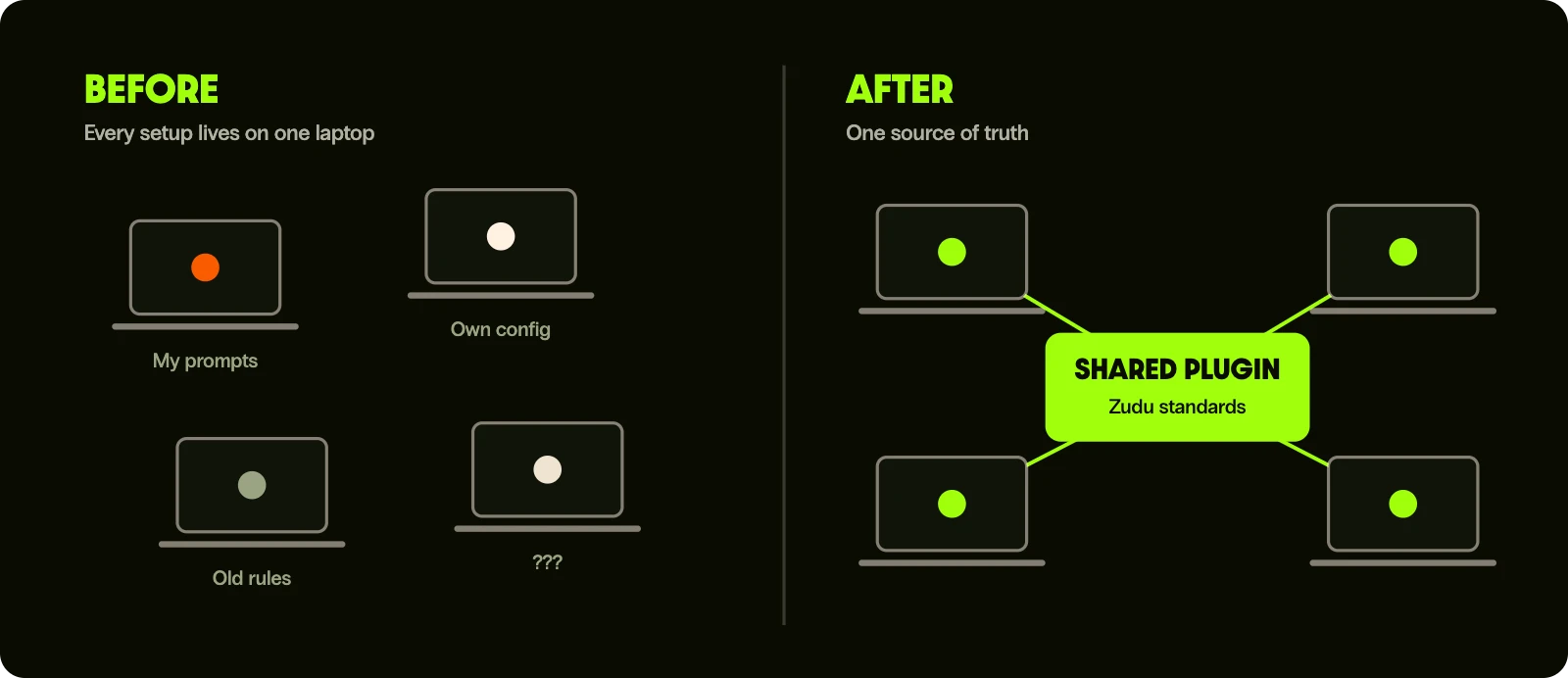
So I wanted one source of truth that everyone’s AI works from, instead of each of us keeping our own. I built a shared plugin for our AI tooling that brings our engineering standards into every session. A developer starting a new feature doesn’t need to go looking for our conventions, security expectations or pull request checklist. The assistant starts from the same guidance as everyone else, and the few rules that really matter are checked automatically rather than left as advice.
Developers come and go. Standards should stay.
Before AI, what we expected from a developer was fairly clear: know your stack, follow the team’s conventions and write code other people can pick up. AI has changed that a bit. Now a lot of how someone works lives in their prompts and their setup, and that’s much harder for anyone else to see.
It’s easy to judge AI adoption by what individual developers can do. One engineer has a brilliant workflow; another has a set of prompts that saves hours every week. But when that knowledge stays with the individual, it’s fragile. When that developer leaves, their setup leaves with them. It’s the same lost-context problem I walked into on day one, just faster.
When I shared the plugin, one colleague mentioned he already had a similar setup of his own, which was more or less the point. Good techniques were already scattered across the team, each one sitting on a single laptop.
So the plugin is open to contributions. If someone finds a better way to review a pull request or structure a commit, it goes into the shared plugin rather than their personal config, and the standards get a bit better each time.
An AI-confident developer is an asset. An AI-confident company is a capability.
What makes it stick
A few things I’ve learned from rolling this out:
- Start with the standards you already have, because AI will happily amplify a bad process.
- Enforce a few rules and advise on the rest. With too many hard blocks, people just work around the tooling.
- Make setup easy to diagnose. A single health-check command turns “it doesn’t work for me” into a list of fixes.
- Treat it like any other product, so version it, review changes through pull requests and listen to the people using it.
- Judge it by your newest starter rather than your best engineer. If someone in their first week ships work that meets your standards, it’s working.
What a year taught me
Every codebase gets handed over eventually. To a new developer, a new team, or to you, two years from now, wondering why on earth you did it that way. The quality of that handover is decided long before it happens, every time someone makes a choice and either writes down why or doesn’t.
That’s what I want to look at next. Documentation is only useful if you know whether a decision still applies. A reversed decision or a temporary workaround can look exactly like the real plan, to a person skimming and to an AI searching. I’d like to find a better way of keeping track of that.
It’s something I want to keep improving at Zudu, with a team that’s been open to trying new approaches and changing how we work. Hopefully it means the next person who picks up one of our projects doesn’t start with a mystery.
Here’s to year two.